

Before sending stock to a fulfillment warehouse in China, confirm its receiving rules, create one accurate product and carton record, and make sure the physical labels match that record. Then agree on delivery, discrepancy handling, and the point at which received stock becomes available for orders. Use the warehouse’s written inbound guide as the final standard; requirements vary by provider.
Confirm the receiving requirements before dispatch
The checks below are a preparation framework. Each provider may have different label formats, carton limits, booking steps, and inspection services. Ask the warehouse to confirm the following in writing before the supplier packs the shipment, then share the approved instructions with both parties.
- Whether it accepts your product category and any special handling requirements.
- The SKU and barcode formats it can identify at unit, carton, and pallet level.
- Packaging rules, carton limits, pallet specifications, and mixed-carton requirements.
- Whether it needs an advance shipment notice, delivery booking, or receiving labels.
- How shortages, overages, damage, unidentified stock, and relabeling are reported and handled.
- Which receiving, inspection, storage, and additional-work charges may apply.
Build one reliable product and carton record
Create a product master before the supplier packs the shipment. Use a stable SKU for every separately stocked variant, and have the warehouse confirm how that SKU maps to its barcode and your store listing. Treat bundles and multipacks as separate setup decisions; do not assume they will be assembled or identified automatically.
Use measurements from the finished, packed product and the final shipping carton rather than an unfinished sample or estimated carton size. For a set or multipack, record whether it arrives as one sealed selling unit or as separate pieces that need work before it can be stored or picked. Keep an approved product photo with the record so the supplier and warehouse can identify each variant.
| Record | What to include or confirm |
|---|---|
| SKU and description | Exact product, color, size, and version |
| Barcode | Identifier and format accepted by the warehouse |
| Selling unit | Single item, multipack, or assembled kit |
| Finished-unit measurements | Packed dimensions and weight of the sellable unit |
| Carton configuration | Carton identifier and units of each SKU per carton |
| Shipping-carton measurements | Actual outer-carton length, width, height, and gross weight |
| Handling details | Fragility, storage needs, or restricted components |
| Traceability | Batch, serial, or expiry details where relevant |
Make labels readable and unambiguous
Ask which identifier the warehouse expects to scan on each individual product, carton, and pallet. Keep those labels distinct: an outer-carton label should make the contents easy to identify without guessing which variant is inside.
GS1 highlights contrast, print quality, placement, and clear space around a barcode as factors that affect scanning. Before approving a production run, check a physical sample using the steps below. Do not crop, stretch, or distort barcode artwork to make it fit; keep its proportions and surrounding clear space intact. Remove or cover obsolete logistics labels only as agreed, and keep required product information visible.
- Print a sample using the intended label stock and printer.
- Apply it to the actual product packaging.
- Scan it and confirm that it returns the intended identifier.
- Send a clear photo to the warehouse if it needs to approve label placement.
Define receiving checks and product inspection separately
“Check quality” is too vague to guide warehouse work. Specify the agreed checks, such as confirming the variant, counting units, checking that listed accessories are present, noting visible carton damage, or performing a particular functional test.
Receiving and product inspection are not automatically the same service. Confirm whether the warehouse checks carton counts and outside condition only, opens cartons, verifies individual units, takes photos, or performs any additional inspection. Put the sample size or inspection method, evidence required, exception process, and any extra charges in writing.
If a discrepancy is found, agree whether the affected stock should be held, reworked, returned, or released after your approval. Ask the supplier to resolve known defects before collection. Mark any stock that needs a decision so it is not released for orders by mistake.
Pack for inbound receiving and outbound orders
Plan separately for bulk delivery to the warehouse and for individual customer orders leaving it. Ask whether the retail packaging can also protect the item during parcel delivery or needs an additional layer.
Where practical, use one SKU per carton and keep quantities consistent across full cartons. If a mixed carton is necessary, get approval and provide a carton-level contents list. Give the supplier clear instructions about fragile components, carton closure, product movement, and any approved protective materials.
Make exceptions visible. Record the actual quantity in partial cartons, separate damaged packaging, and identify complete kits as sellable units. If inserts or custom mailers will arrive separately, list them in the receiving plan too.
Prepare shipment documents for the actual route
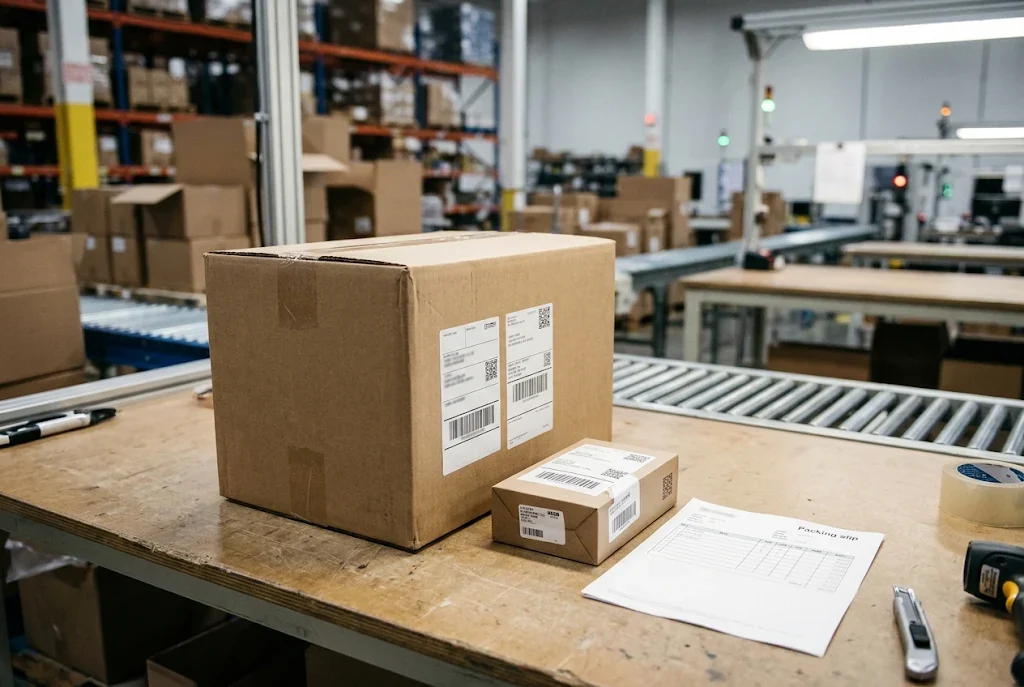
Prepare a packing list that identifies cartons, SKUs, and quantities, along with any receiving notice or labels required by the warehouse. Confirm the route before deciding whether customs documents are needed: a supplier delivery within mainland China differs from goods crossing into China or moving through Hong Kong or a bonded facility.
For a cross-border movement into China, ask the responsible forwarder or customs broker which documents and product approvals apply to the actual goods. Requirements vary by product and route. The U.S. International Trade Administration’s China import requirements guide is a starting reference, not a substitute for confirmation from the party handling the shipment.
Before collection, compare the final packed shipment with the records. If the supplier changes a quantity, removes a carton, or splits the delivery, update the packing list and receiving notice and tell the warehouse.
Coordinate the supplier-to-warehouse handoff
Assign one person to approve the final quantities, records, and dispatch. Share the same approved instructions with the supplier, carrier, and warehouse.
Before release, ask the supplier for photos of finished units, visible carton labels, and the complete shipment. Compare them with the product and packing records; photos can help catch visible mismatches, but they do not replace any inspection you have agreed with the warehouse.
Send the warehouse the expected arrival date, shipment reference, carton count, carrier contact, and approved exceptions. Confirm the receiving address, contact details, delivery hours, and any booking procedure in the format the local carrier needs. Ask the supplier to report split shipments, substitutions, or missed collections before they arrive as unexplained differences.
Reconcile received stock before releasing orders
Delivery confirmation alone does not show that stock has completed receiving or is ready for fulfillment. Ask the warehouse what status means that inventory has been counted, discrepancies resolved or recorded, and stock made available for order processing.
Compare the receipt against your shipment records by SKU. Review accepted quantities, shortages, overages, damaged units, and stock awaiting identification or approval. Request a recount or supporting evidence when the numbers do not match, and record the agreed resolution.
If warehouse inventory information is passed to your store or another system, confirm the actual method and how received, available, reserved, and held stock are represented. Test the process before relying on automatic inventory updates or promising a particular integration.
Once the stock is available, run a controlled test order if the service scope allows it. Verify the picked variant, included accessories, packaging instructions, and tracking handoff before routing regular order volume through the workflow.
Final dispatch checklist
Before the supplier releases inventory, use the checklist below as a dispatch gate.
- The warehouse accepts the product category and handling requirements.
- Every variant has an approved SKU and barcode mapping.
- Finished-unit measurements, outer-carton dimensions and gross weights, and carton quantities match the packing record.
- Sample labels have been checked on the actual packaging.
- Receiving and any additional inspection scope are documented.
- Carton contents match the packing list and receiving notice.
- Route-specific document responsibilities are assigned.
- Delivery details, arrival timing, and warehouse contacts are confirmed.
- Someone is responsible for reconciling received stock before order release.
Start with a clear fulfillment scope
Good preparation aligns the physical inventory, labels, and shipment records before dispatch—and verifies the receipt before stock is offered for fulfillment. If you are evaluating one-piece fulfillment from China, share your SKU list, carton details, expected order profile, and destination markets with the provider so it can confirm the applicable receiving and order-handling scope.
FREQUENTLY ASKED QUESTIONS
Questions to ask before booking.
What information should I send before inventory arrives?
Share the SKU and variant list, barcode details, carton quantities and measurements, expected arrival date, delivery contact, and any special handling instructions. Use the warehouse’s own inbound guide to confirm the required fields.
Does warehouse receiving include a product quality inspection?
Not automatically. Confirm whether the receiving scope covers carton counts and visible condition only, or includes opening cartons, checking individual units, photos, or functional tests.
Does every fulfillment warehouse require a barcode on each unit?
Requirements vary. Ask which identifier the warehouse scans at unit, carton, and pallet level, and confirm accepted formats before labels are printed.
Can customer orders be fulfilled as soon as inventory is delivered?
Arrival does not necessarily mean stock is ready for orders. Confirm the receiving and reconciliation steps, resolve or record discrepancies, and verify when the warehouse marks inventory available.
Sources and further reading
GS1 guidance supports the barcode checks in this article. Product- and route-specific import requirements should be confirmed with the party responsible for the shipment.