

Shipment consolidation from China coordinates goods bought from multiple suppliers so they can be received, checked against agreed instructions, and dispatched under one shipment plan. This is often called buyer consolidation. It describes how a buyer's orders are brought together; LCL describes cargo sharing a container with other shippers. Consolidated orders may move by air, LCL, FCL, or parcel services, depending on the cargo, destination, timing, and provider's available options.
Start with one coordinated origin plan
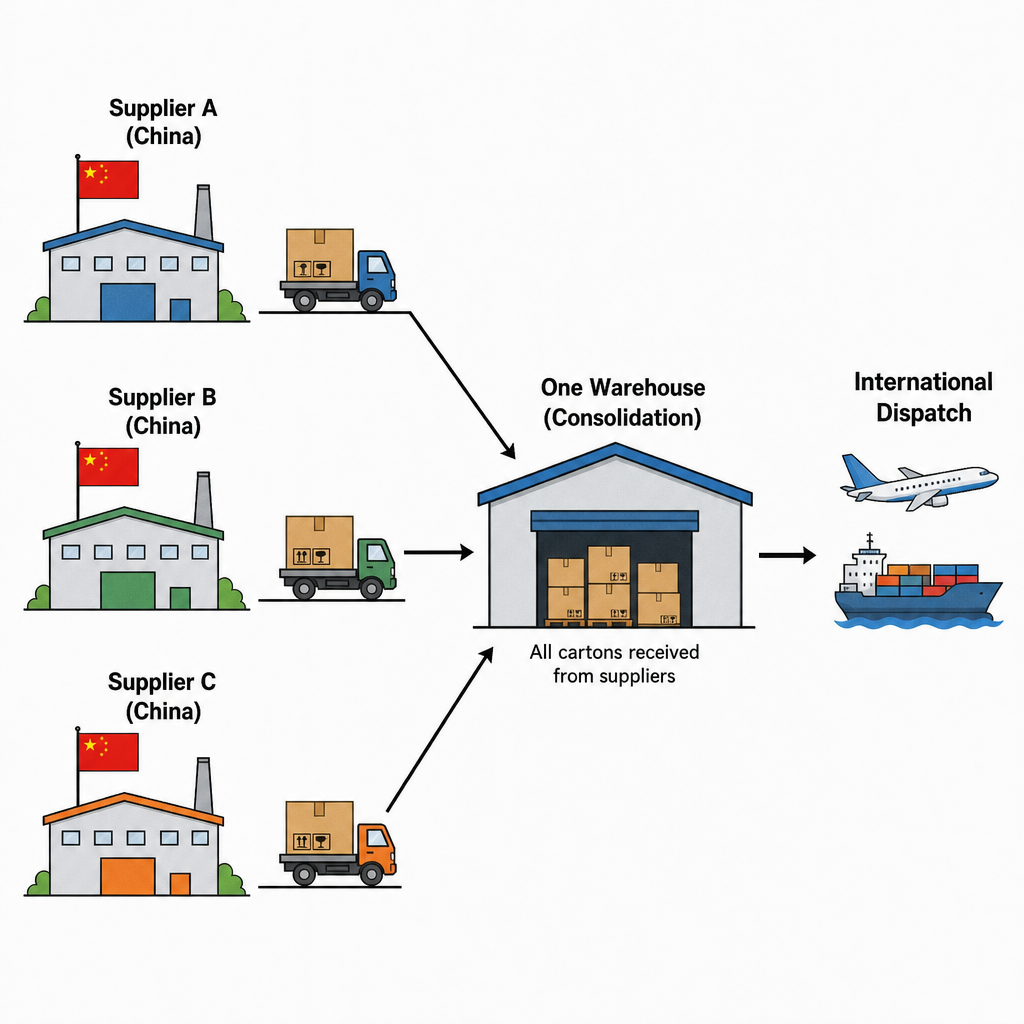
When one purchase order is ready before the others, booking every supplier's goods separately can create several pickups, documents, handoffs, and delivery dates to manage. Shipment consolidation gives the buyer one coordinated origin plan: suppliers send cargo to an agreed receiving point, where the shipment is prepared for onward transport according to a written scope.
It can make inbound operations easier to coordinate, but it does not guarantee a lower total cost or faster delivery. The result depends on supplier timing, warehouse work, transport choices, and origin and destination charges. Start by understanding what is being consolidated and who is responsible at each handoff.
Buyer consolidation and LCL are different decisions
Buyer consolidation describes the sourcing and receiving arrangement: one buyer's orders from multiple suppliers are brought together at origin. Less-than-container load (LCL) describes an ocean-freight arrangement in which cargo shares container space with other shippers.
They answer different questions. Multiple suppliers' deliveries can be coordinated for one buyer and then sent as FCL, LCL, air freight, or suitable parcel services. A forwarder must confirm which options are available for the actual goods and route. C.H. Robinson's buyer-consolidation guide describes buyer consolidation as coordinating suppliers' LCL deliveries into a shipment for one consignee; Flexport's LCL glossary explains the container-sharing term.
| Term | What it describes | Question it helps answer |
|---|---|---|
| Buyer consolidation | Bringing one buyer's orders from multiple suppliers together at origin | How will separate supplier deliveries be coordinated? |
| LCL | Sharing ocean-container space with cargo from other shippers | How will a shipment smaller than a full container move by sea? |
| FCL | Booking a container for one shipment/consignee under the agreed service | Does the planned cargo and route suit a dedicated container? |
Plan the shipment around supplier readiness
Before requesting a combined dispatch, create one order register and share the receiving instructions with every supplier. A useful register includes:
Set a receiving deadline and a separate dispatch target. Ask the provider how much time it needs after the last planned arrival to receive cargo, report discrepancies, complete the agreed work, and book transport. Use packed dimensions and weight from the actual shipping cartons, not product dimensions alone.
- Supplier name, purchase-order reference, SKU or product description, and consignee.
- Carton count, packed dimensions, gross weight, and any handling restrictions.
- Factory-ready date, expected warehouse-arrival date, and actual arrival status.
- Commercial invoice and packing-list status, plus any route-specific documents.
- Required warehouse work, such as receiving counts, photos, labeling, or repacking.
Decide what to do when a supplier is late
Do not let the latest supplier date make the decision by default. Compare two workable plans:
Compare the extra transport and handling cost with the business cost of delaying stock. Also check whether the goods can be booked together safely and whether the destination or product rules require separate handling. Agree on a cutoff and approval contact before cargo starts moving.
- 1. Hold the ready cargo until the late order arrives, including any storage or schedule impact.
- 2. Dispatch the ready cargo and send the late order separately or in a later consolidation.
Choose the transport plan after the cargo is ready
There is no universal shipment-size threshold at which one mode becomes cheapest. Ask for options using the same cargo list, packed measurements, origin scope, destination, and delivery scope.
Mode selection is separate from supplier consolidation. Cargo from several suppliers can be coordinated before booking, but compatibility, export documentation, and the provider's operating rules still need to be checked.
| Option | Consider it when | Confirm before booking |
|---|---|---|
| Parcel service | The cargo is already packed as individual parcels or can be prepared that way | Parcel limits, goods acceptance, destination coverage, and final-mile scope |
| Air freight | The shipment needs an air-cargo plan and the cargo is accepted on the route | Chargeable weight, handling, cutoffs, and delivery scope |
| Sea LCL | The ocean shipment does not use a dedicated container | Origin and destination handling, minimum charges, deconsolidation, and delivery |
| Sea FCL | A dedicated container is practical for the cargo and route | Container size, loading plan, utilization, and all-in charges |
Compare total cost and timing, not only the freight line
Request an itemized comparison between separate dispatches and a consolidated plan. Keep the delivery scope the same so you can compare like with like. Include:
Ask which services are included, which are optional, how storage is counted, and when charges begin. A lower international-freight line can still produce a higher total if additional handling or delivery charges are outside the quote. Request written assumptions and compare the final invoice with the agreed scope.
- Supplier pickups or domestic delivery to the receiving warehouse.
- Receiving, storage, inspection, sorting, labeling, repacking, or palletizing that you request.
- Export handling, documentation, international transport, and applicable surcharges.
- Destination handling, customs-related services, final delivery, and charges excluded from the quote.
- The inventory or sales impact of waiting for a late supplier.
Define the warehouse's receiving and repacking scope
Warehouse receiving is a checkpoint, not automatically a product-quality inspection. Confirm whether the provider checks carton counts and outside condition only, opens cartons, verifies unit counts, takes photos, or reports visible damage. Ask how mismatches are recorded and whether the cargo will be held for your approval.
Give written repacking instructions. Specify which packaging may be removed, what must be protected, whether cartons from different purchase orders can be combined, and whether labels or retail packaging must remain intact. If the cargo is for a marketplace or retailer, provide the shipment-specific preparation and labeling rules; do not assume general consolidation includes them.
Prepare documents and flag restricted goods early
Keep each supplier's product and commercial records traceable to the consolidated cargo. Provide accurate product descriptions, quantities, values, origin details, and packing information as required for the destination and agreed customs process. For US-bound cargo, CBP says cargo descriptions should identify the commodity clearly, and its invoice guidance lists information required with entry documents. Confirm current requirements with your customs broker rather than treating one destination's rules as universal: CBP cargo-description guidance and CBP commercial-invoice guidance.
Tell the provider about batteries, liquids, chemicals, magnets, and other potentially restricted goods before collection. Provide product specifications and requested documents, then obtain written confirmation that the goods are accepted for the proposed route. Lithium-battery requirements depend on the battery and how it is shipped; use current carrier and regulatory instructions. IATA's 2026 battery guidance is a reference, not a substitute for checking the applicable rules and carrier acceptance.
Questions to ask a consolidation provider
Before sending goods, ask the provider to confirm:
Request the answers in writing and test the workflow with a limited shipment when the process is new. Review communication, receiving records, and invoice accuracy as well as transit performance.
- 1. The receiving address, delivery rules, cargo labels, and latest arrival cutoff.
- 2. Which checks and warehouse tasks are included, optional, or unavailable.
- 3. How supplier arrivals, discrepancies, photos, and inventory status will be reported.
- 4. What happens if an order misses the cutoff, including storage and split-shipment options.
- 5. Which transport modes and destinations can be quoted for the actual goods.
- 6. Which documents, charges, customs responsibilities, and delivery steps are included or excluded.
- 7. Who can approve extra work and release the consolidated shipment.
Plan a coordinated shipment from China
Share your supplier list, cargo details, readiness dates, destination, and required warehouse work to discuss a shipment plan. Confirm the scope and charges before goods are dispatched.
FREQUENTLY ASKED QUESTIONS
Questions to ask before booking.
Does shipment consolidation from China always mean LCL?
No. Consolidation describes coordinating deliveries from multiple suppliers for one buyer. LCL is one ocean-freight option. Depending on the goods and route, consolidated cargo may move by FCL, LCL, air freight, or parcel service.
Can goods from different suppliers go into one shipment?
They can be coordinated for one buyer when the receiving point, timing, cargo details, documents, and handling requirements align. The provider must confirm compatibility and the available booking plan before dispatch.
Will consolidation reduce my shipping cost?
Not in every case. Compare the full cost of separate dispatches with the consolidated plan, including domestic collection, warehouse work, storage, international freight, destination charges, delivery, and the cost of waiting.
What information should I send before requesting a quote?
Provide supplier locations, product descriptions, carton counts, packed dimensions and gross weights, ready dates, destination, requested warehouse tasks, and any special cargo details. Complete data helps providers quote a defined scope.
Sources and further reading
These references support the consolidation definitions and U.S.-specific documentation guidance in this article. Requirements depend on the goods, route and parties involved; confirm shipment-specific obligations with the relevant authority or customs broker.